
Farm traceability · Kenya
Trace every pack back to the farm in seconds.
Farm to Fork records each step from plot to pallet: sprays, harvests, deliveries, packing and shipments. When a buyer, auditor or regulator asks where it came from, you answer with one scan.
- GS1 Digital Link labels
- EPCIS 2.0 event record
- English and Kiswahili
- Farmer consent built in
Why exporters switch
Sound familiar?
Fresh produce changes hands five or six times between the plot and the plane. Each handover is a chance for the record to break.
Buyers ask where it was grown
An importer wants proof of origin for one carton, and the answer is in three notebooks.
Spray records live on paper
A late spray slips through and the container is rejected for residues at the border.
Weights that never reconcile
Delivered, batched and packed kilograms disagree, and no one can say where the difference went.
A recall takes days
You know the lot is affected, but not which pallets, shipments and buyers it reached.
Farmers paid on trust alone
Receipts are handwritten, so disputes about kilos and grades are hard to settle.
Farm to Fork writes each step down when it happens, so the whole chain is on record before anyone asks.
How it works
From plot to pallet in four steps
Each step is a normal job your team already does, recorded in the browser on a phone, tablet or computer.
Register farmers and plots
- Farmer consent recorded in English or Kiswahili
- Farms and mapped plot boundaries
- Printed farmer cards with a QR code
Record in the field and at the scale
- Sprays from your approved list, with PHI and MRLs
- Harvests, deliveries, grades and rejects
- A receipt for every farmer
Pack and ship with GS1 labels
- Dispatches, custody handovers and intake QC
- Pack lots with GTIN, lot and best-before
- SSCC pallets and shipments to buyers
Trace, recall and share
- Backward and forward trace in seconds
- Timed mock recalls
- A QR page on every pack and a buyer portal
What you get
One record from the farm gate to the buyer
Real screens from the Farm to Fork demo. Each role sees only the menus it needs.
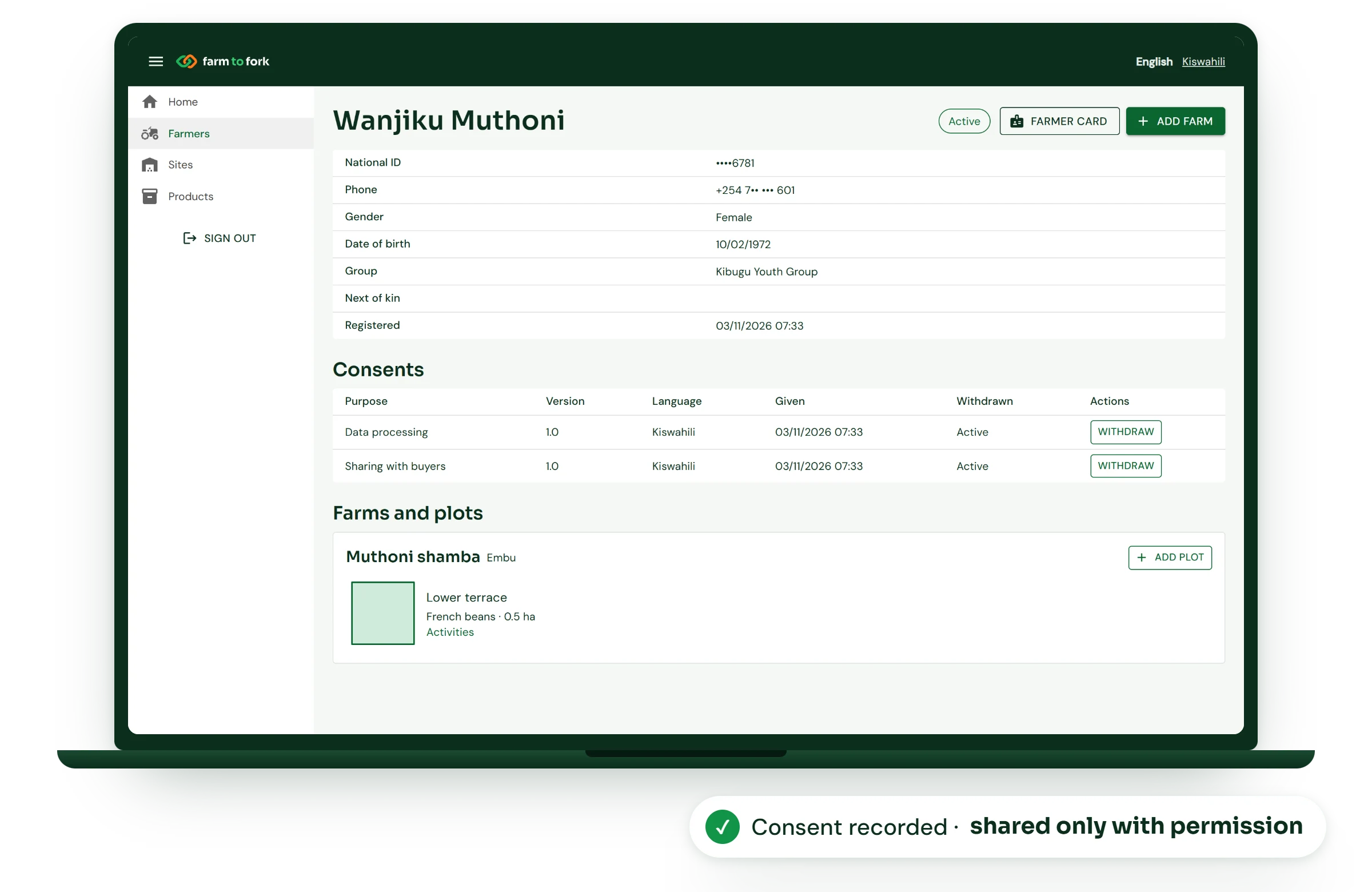
Farmer registry
Every farmer, farm and plot on record
Register farmers once, with their consent, and map each plot. Phone numbers and ID numbers are stored encrypted and always shown masked.
- Consent for data processing and for sharing with buyers, in English or Kiswahili
- Plot boundaries with area checks and overlap warnings
- Bulk import from a spreadsheet, and farmer cards with a QR code
Field records
Sprays and harvests checked before they cost you a container
Field officers record plantings, sprays and harvests against your approved agrochemical list. The system knows each product’s pre-harvest interval and residue limits.
- Harvests and deliveries inside the PHI are refused at the scale
- MRL risks flagged per market: EU, UK and US
- Each harvest becomes a lot that the delivery is linked to
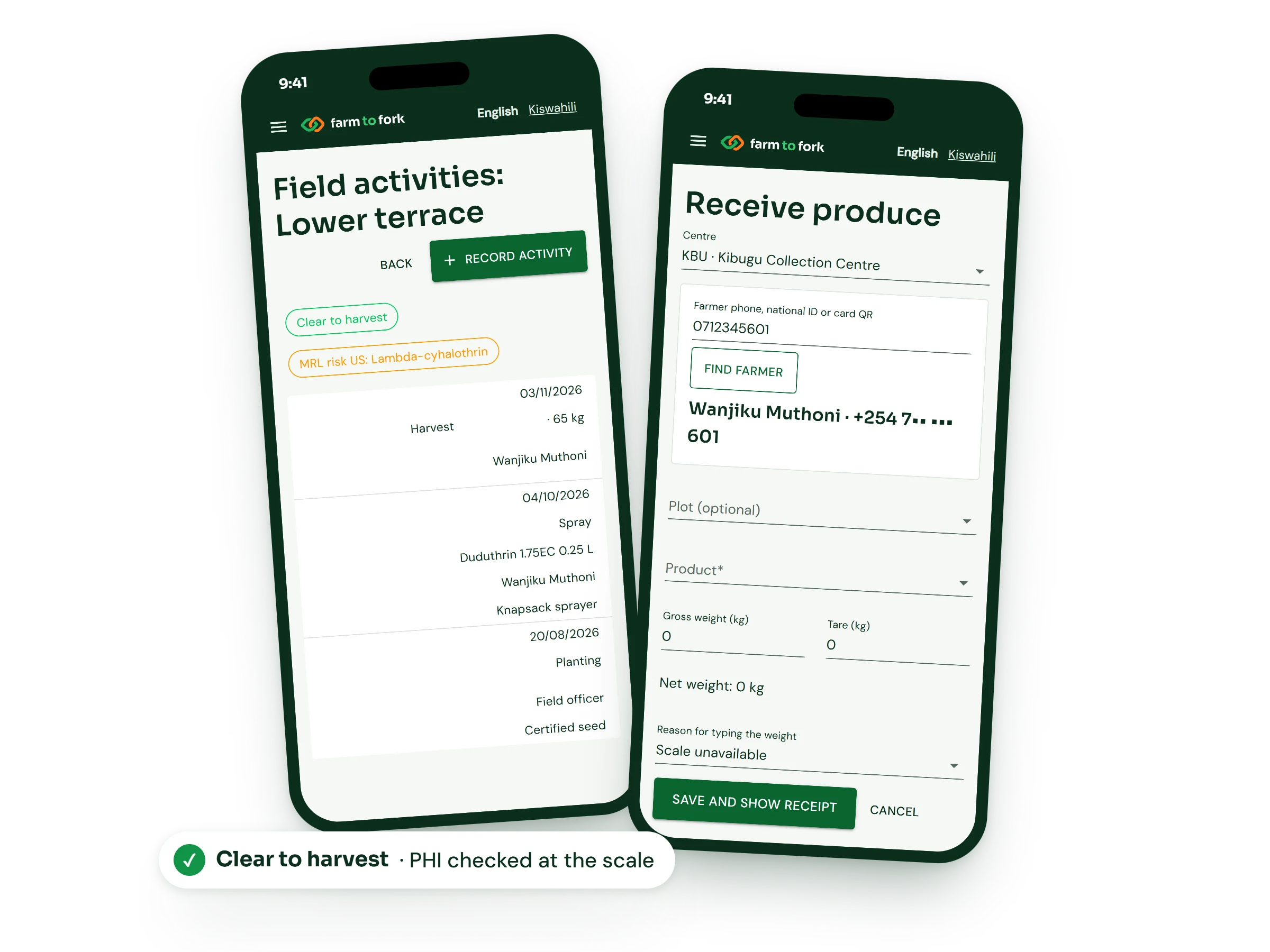
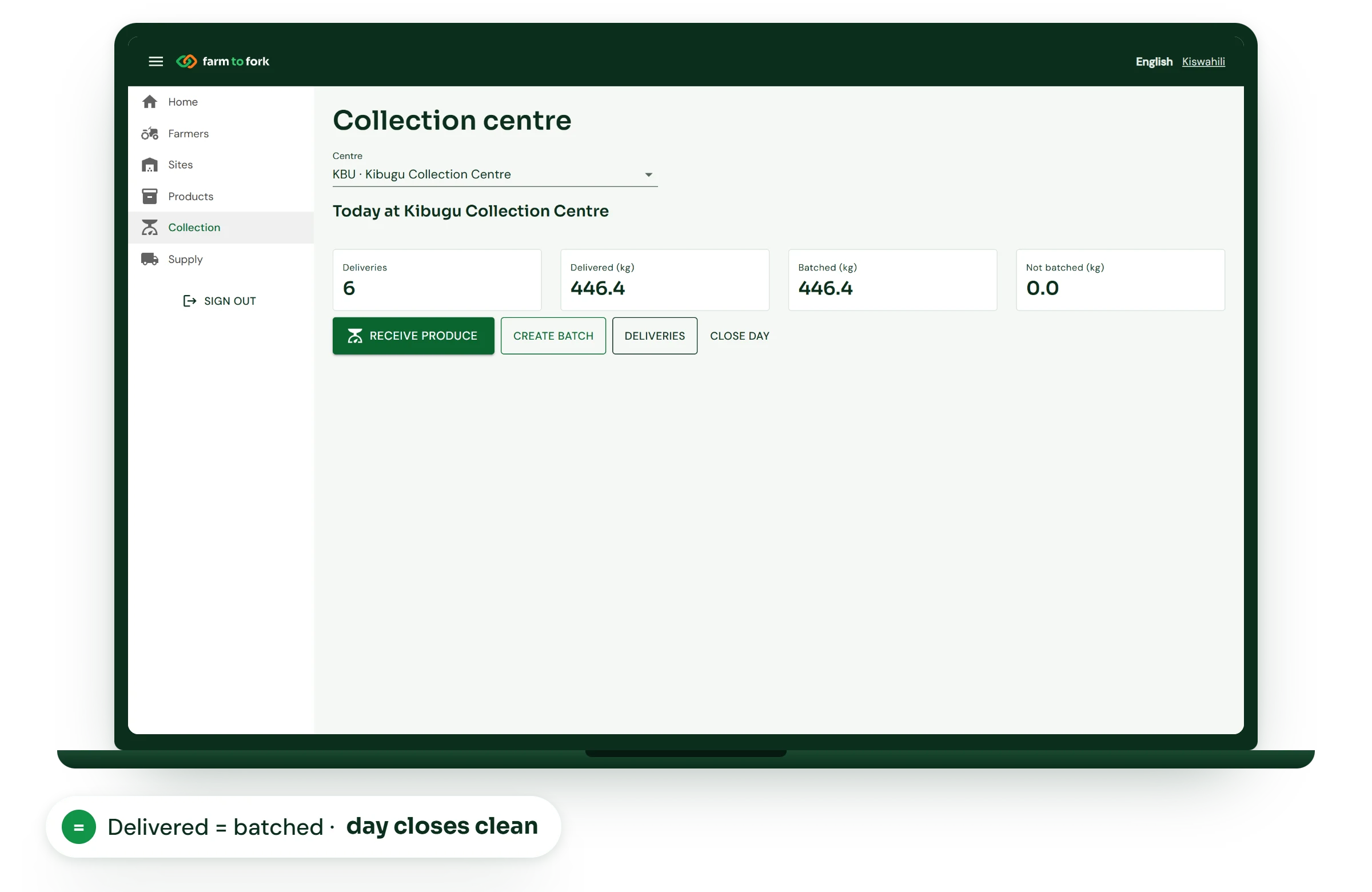
Collection centres
Weights and grades that add up
Clerks find the farmer by phone, ID or card, weigh, grade and print a receipt that can never be changed. Deliveries are pooled into batches and the day is closed against the scale.
- An 80 mm thermal receipt for every delivery
- Batches with printed labels
- Day close reconciles delivered and batched kilograms
Pack house and logistics
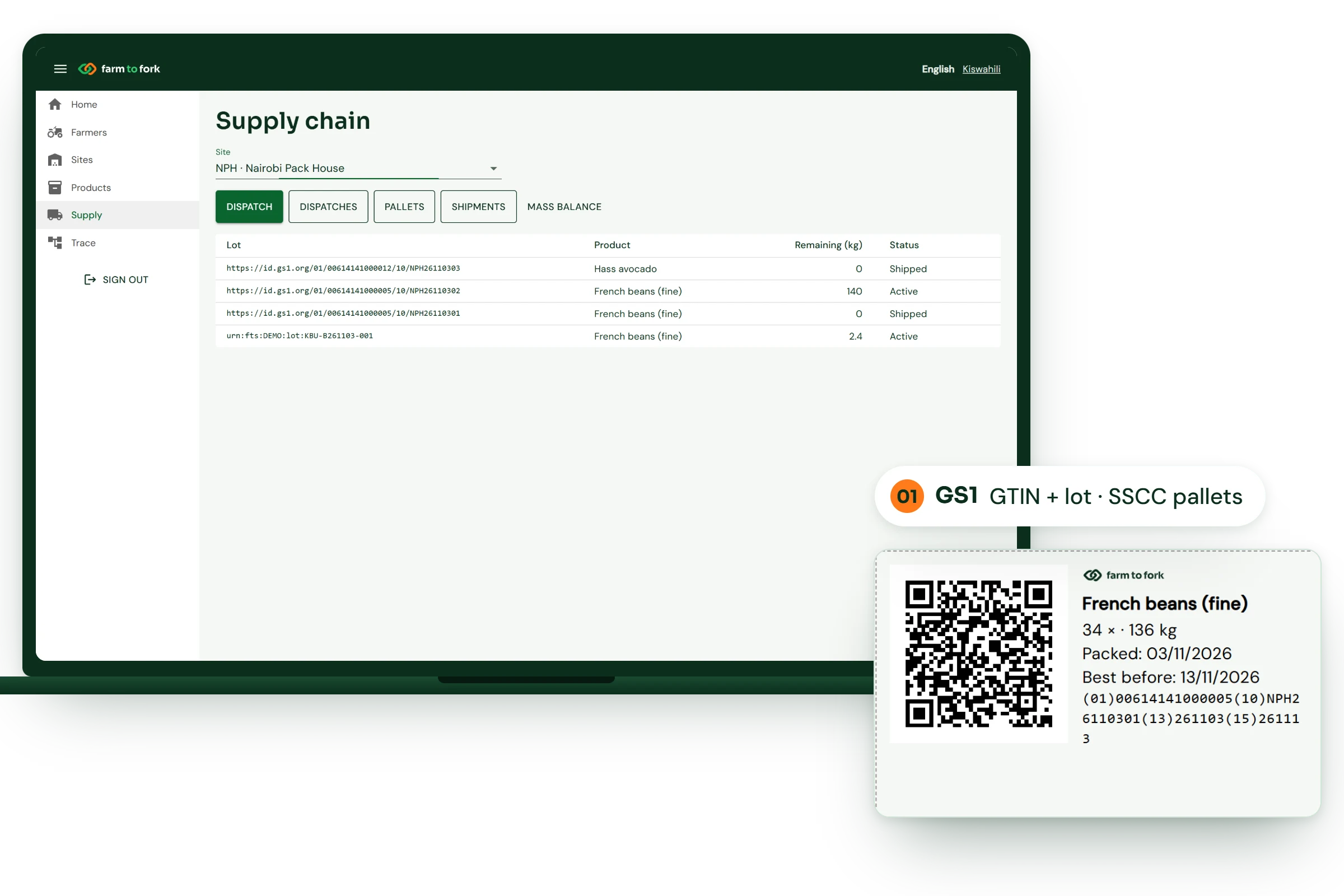
Dispatch, pack and ship on GS1 standards
Lots move between sites with seals and custody handovers. The pack house receives with intake QC, packs into GTIN-and-lot pack lots, builds SSCC pallets and ships them to buyers.
- Intake QC: accepted, held or rejected, with notes
- Pack labels with a GS1 Digital Link QR, pallet labels with an SSCC
- Mass balance flags output that exceeds input
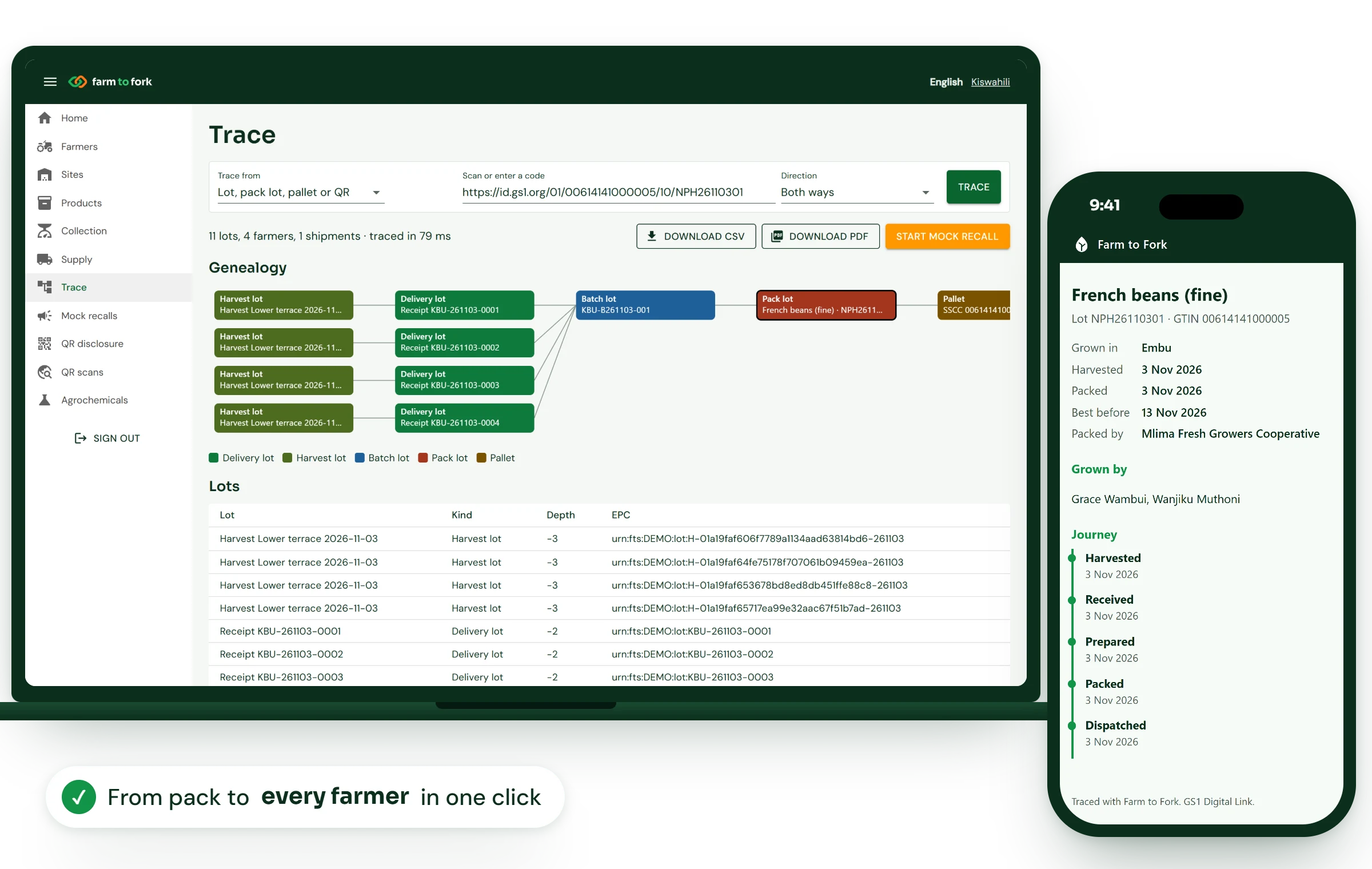
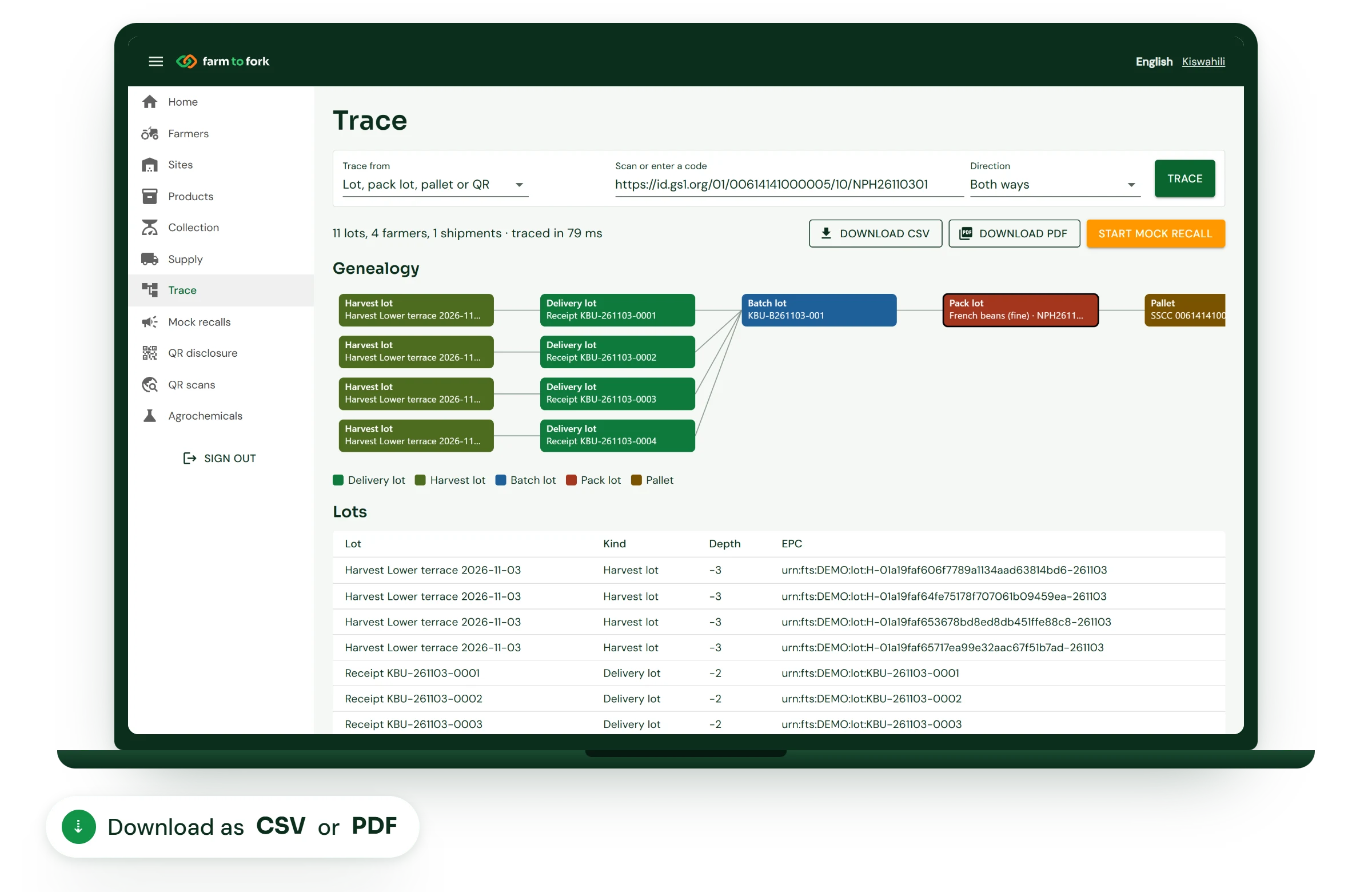
Trace
Any pack to every farmer, in one click
Scan a pack, a pallet or a batch, or start from a farmer, a plot or a spray product. Farm to Fork walks the chain both ways and draws it.
- Farmers, plots, field activities, handlers, shipments and buyers
- A genealogy graph and the same data as tables
- Download the report as CSV or PDF
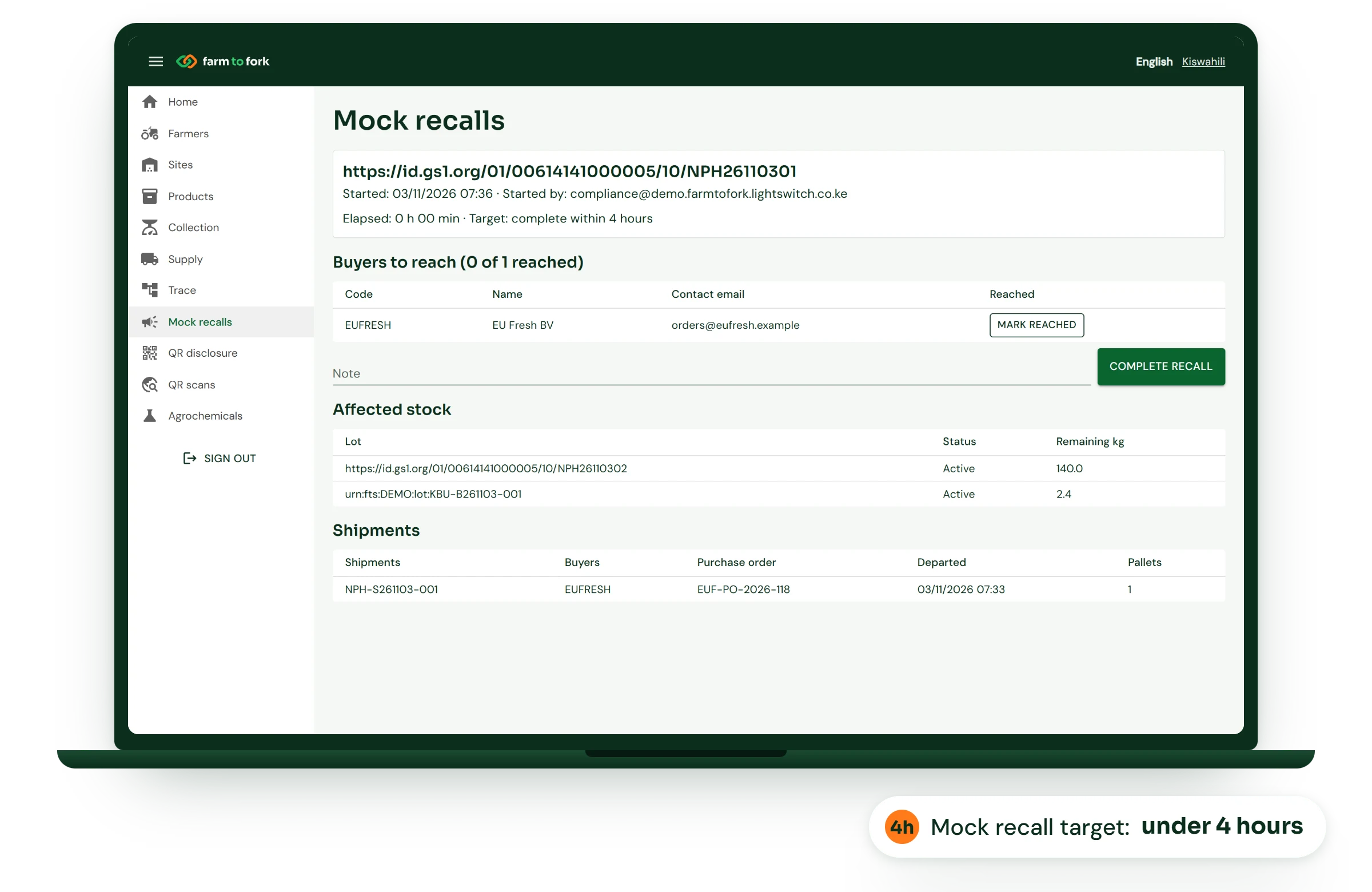
Mock recalls
Every affected buyer, reached in under four hours
Start a timed recall drill from any lot. It finds the sources, everything made from them, the stock still on hand and every buyer to contact, then times you against the target.
- Sibling lots from the same batch are included
- Mark each buyer reached, with a note
- The duration is recorded against the 4-hour target
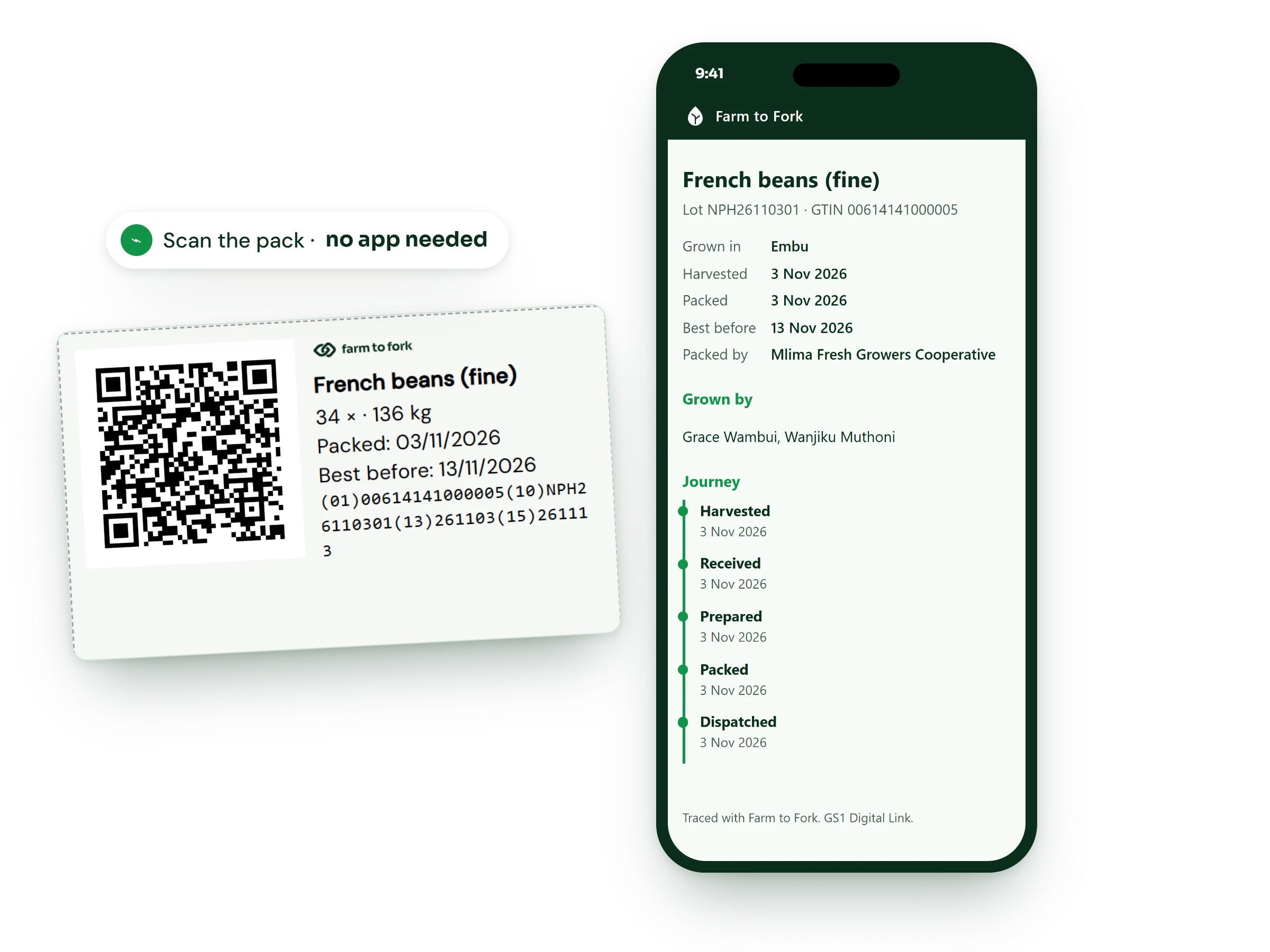
QR page
A page for every pack, for anyone with a phone
Consumers and inspectors scan the QR code on the pack and see its origin, dates and journey. You choose what is public, and scans from unexpected countries are flagged.
- No app and no sign-in; fast on a slow mobile connection
- Farmer names only where the farmer agreed
- Scan alerts can reveal diverted or counterfeit goods
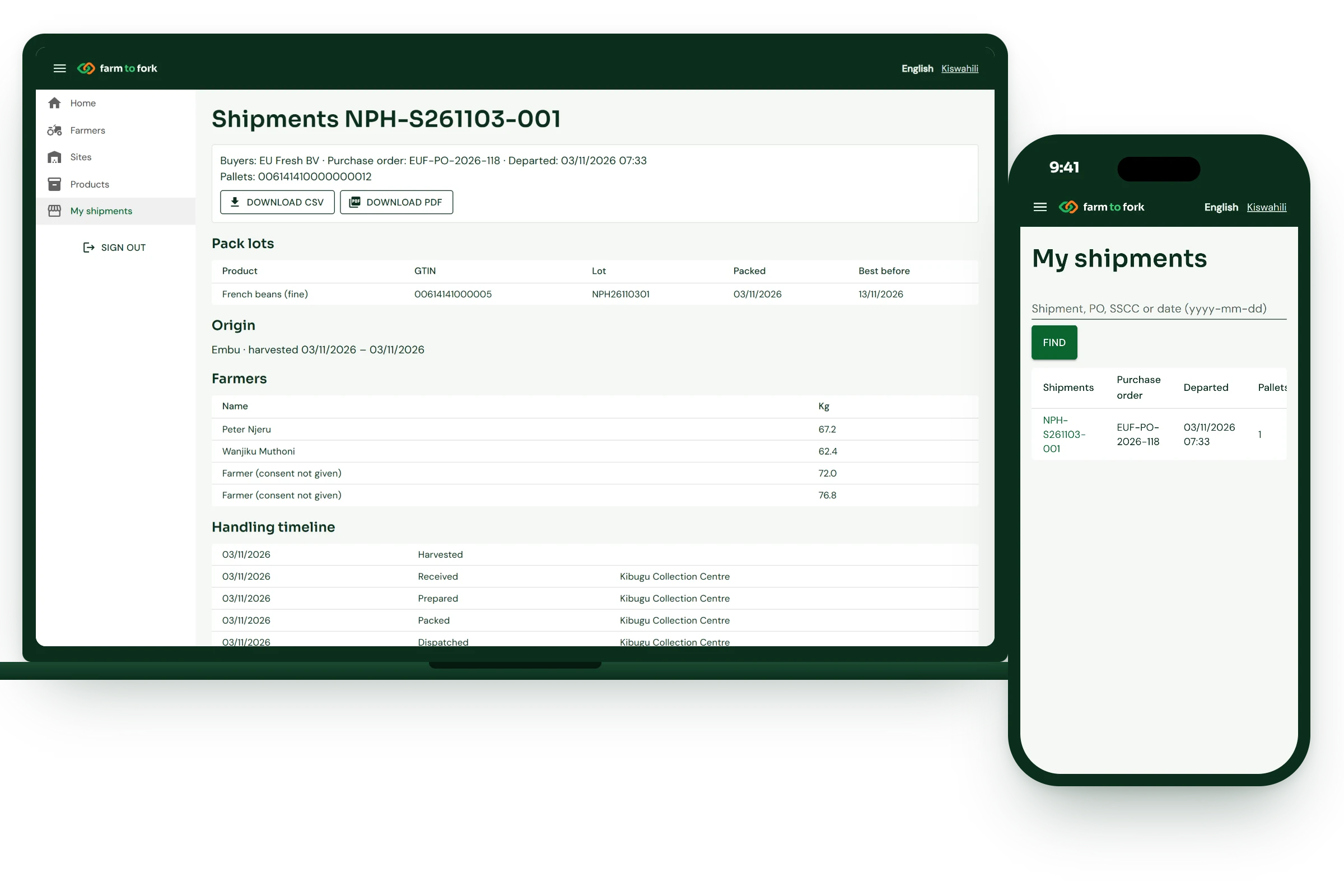
Buyer portal
Your buyers see their own shipments
Give each importer a sign-in. They see only their shipments, the pack lots, origin and handling timeline within what you share, and can download it for their own compliance file.
- Search by shipment, PO, pallet SSCC or date
- Farmer names only where the farmer consented to that buyer
- CSV and PDF downloads per shipment
< 5 s
to trace a pack lot fed by 500 farmers (tested)
4 h
mock recall target, timed in the system
150 KB
at most for the public QR page, fast on 3G
2
languages: English and Kiswahili
8
roles, each with its own menu and sites
Who it’s for
Built for everyone between the farm and the shelf
EX
Fresh produce exporters
Answer EU and UK buyers’ origin and residue questions per carton, and run recall drills before an audit does.
CO
Cooperatives
Register members once, weigh fairly at every centre, print receipts and show buyers where the produce came from.
OG
Out-grower schemes
Keep spray and harvest records for every contracted plot, and stop non-compliant produce at the scale.
PH
Pack houses and processors
Receive with QC, pack into GS1 lots and pallets, and prove your mass balance.
BY
Importers and buyers
Get your own portal: your shipments, their origin and the farmers who agreed to share, downloadable.
Trust
A record auditors can rely on
Traceability is only worth as much as the record behind it.
Records that can’t be rewritten
Every traceability event is stored once, in tamper-evident ledger tables. Mistakes are corrected with a new record, never by editing.
Two-step sign-in
Administrators, compliance and finance users must use an authenticator app. Accounts lock after repeated wrong passwords.
Privacy by design
Farmer consent is recorded and can be withdrawn. Phones and ID numbers are encrypted and masked, and never shown to buyers or the public.
Your data stays yours
Each organisation’s data is kept apart from every other’s, and each user is limited to their role and sites.
Compare
Why not a spreadsheet?
| Capability | Farm to Fork | Paper and spreadsheets | Generic software |
|---|---|---|---|
| Trace a pack to its farmers | In seconds | Days of searching | Often lot-level only |
| GS1 labels and consumer QR page | Built in | No | Add-on or custom work |
| PHI check at the collection scale | Refused or flagged | After the fact | Rarely |
| Timed mock recalls | Against a 4-hour target | Manual | Varies |
| Farmer consent and privacy | Recorded and enforced | On paper | Varies |
| English and Kiswahili | Every screen | Whatever is written | Usually English only |
| Support in Nairobi | Lightswitch team | None | Often overseas |
A general comparison, not a review of any named product.
FAQ
Questions we are asked
Which crops does it work for?
Any produce you buy by weight and grade: French beans, avocado, mango, macadamia, tea, coffee, flowers and more. Each product has its own grades, GTIN, shelf life and yield. The demo uses French beans and Hass avocado.
Which standards does it use?
GS1 throughout: GTIN and lot numbers on pack labels, SSCC numbers on pallets, GLN for sites and GS1 Digital Link QR codes. Every step is stored as an EPCIS 2.0 event, the format buyers and regulators exchange traceability data in.
What does a consumer see when they scan the pack?
A short page with the product, where it was grown, harvest, pack and best-before dates, who packed it and its journey. You decide field by field what is public, shown to buyers only, or hidden. Farmer names appear only where the farmer agreed.
Can our buyers see our farmers’ details?
Only what you choose to share, and a farmer’s name only when that farmer consented to share with that buyer. Phone numbers, ID numbers and plot boundaries are never shown outside your team.
Does it work offline in the field?
Farm to Fork runs in the browser on phones, tablets and computers, and needs a connection while you record. A mobile app with offline capture, Bluetooth printing and scale capture is on the roadmap; tell us if it matters to you.
Can it pay farmers by M-PESA?
Not yet. Today Farm to Fork records every delivery, grade and reject with a receipt the farmer keeps, which is what a payment run needs. Paying against those deliveries by M-PESA is planned; ask us about timing.
Where is our data kept?
We host Farm to Fork for you, or install it on your own server. Each organisation’s data is kept separate, and the traceability record is tamper-evident.
Can we try it first?
Yes. The live demo has a sample cooperative with farmers, deliveries, a pack house and two export shipments. Book a demo and we will walk you through it with your own chain in mind.
Free demo
See your own chain in Farm to Fork
A 30-minute demo by Zoom, phone or at your pack house. Bring a real shipment and we will trace it together.
No commitment. We use your details only to arrange the demo.